FP&A · Product Design · 2021–2024
Stratify
Collaborative Expense Planning
Transforming how mid-market finance teams plan budgets — replacing the chaos of emailed spreadsheets with a collaborative, task-based workflow that brought every stakeholder into a single source of truth.
100%
Customer adoption — no customer fell back to Excel
20–30h
Saved per person per month — redirected to strategic work
~100
PEAK design system components powering the platform
The Challenge
Spreadsheet chaos was costing finance teams 20–30 hours a month
Mid-market tech companies scaling from $10–20M in revenue faced a critical bottleneck: financial planning lived entirely in emailed spreadsheets. Finance teams cycled through multiple versions of Excel and Google Sheets, making it nearly impossible to know which version was current or approved. Complex formulas were understood by one person — a key-person risk that could derail the entire planning cycle if they were unavailable.
The consequences were measurable. Finance teams wasted 20–30 hours per person per month chasing files and reconciling conflicting versions. P&L leaders from marketing, sales, and engineering had little ability to advocate for their departments' needs. Finance couldn't be a strategic partner to the business when they were buried in spreadsheet logistics.
"The spreadsheet approach simply wouldn't work as companies scaled — but existing enterprise FP&A solutions were too complex and expensive for mid-market organizations."
The problem reached an inflection point when new CFOs joined growing companies with a mandate to modernize. These were our ideal customers: finance leaders who'd outgrown spreadsheets but weren't ready for heavyweight enterprise tools.
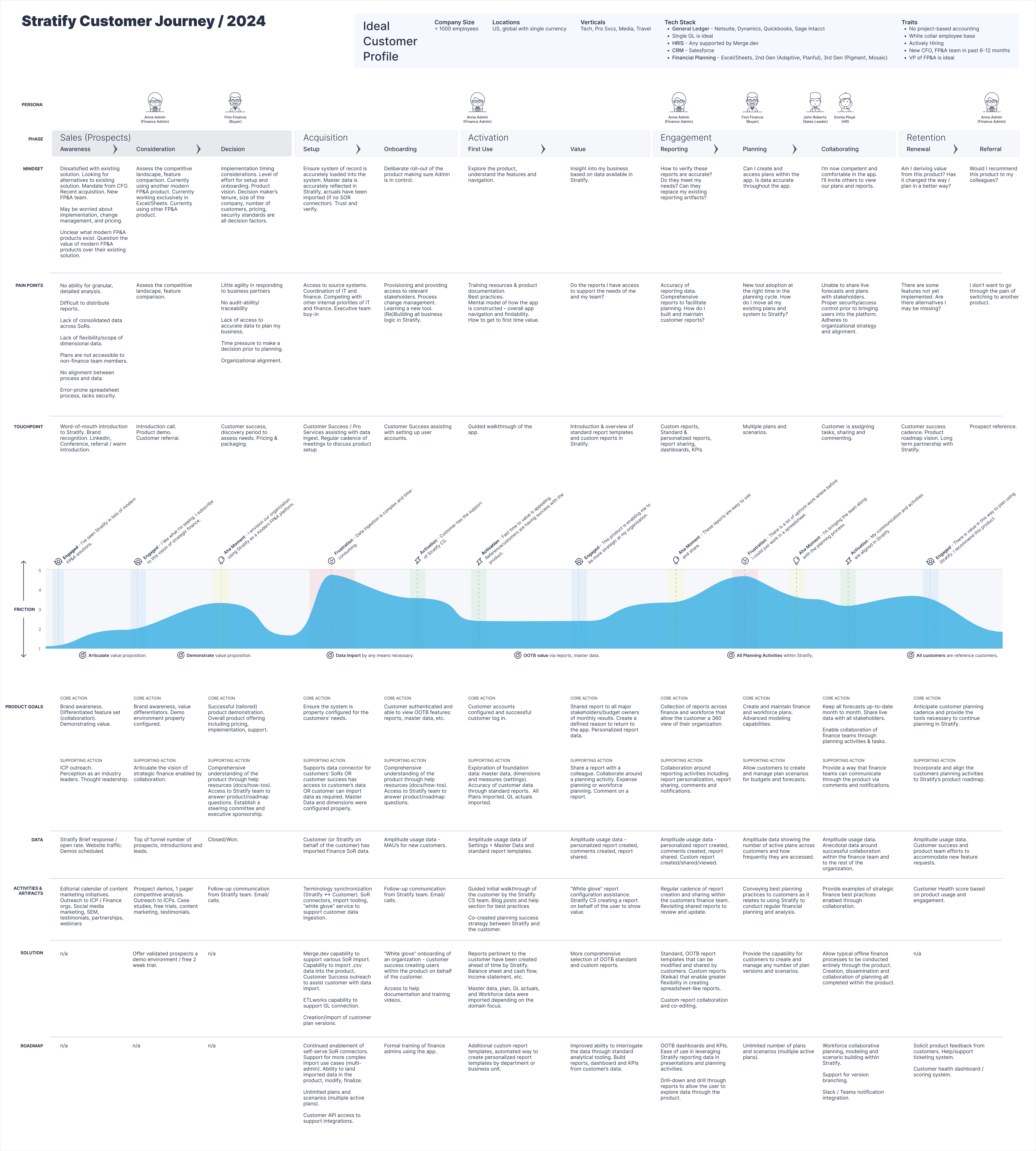
Customer journey map — Research artifact documenting the end-to-end experience from onboarding through budgeting cycle completion, identifying friction points and opportunity areas that shaped the design direction.
My Approach
Bringing all stakeholders into one shared view of the plan
The design challenge was making a genuinely complex workflow feel effortless. Collaborative expense planning required multiple users with different roles, editing the same financial data simultaneously, across time zones. The interface had to support this complexity without exposing it unnecessarily.
The core of the design is a task-based approval workflow built on interactive data grids (powered by AG Grid). P&L leaders — a VP of Marketing planning software expenses, for example — can input their department's budget directly in the grid and submit for approval. Finance leaders see all plans in one view, can model scenarios, and route approvals accordingly.
- Task workflow engine — Clear states (not started, in progress, completed, approved, rejected) visible differently to P&L owners and finance admins.
- Threaded comments — @mention colleagues on specific line items, replacing email chains with contextual in-product discussions.
- Scenario planning — Finance leaders create multiple plan versions to model different budget options before locking the approved plan.
- Concurrent editing with locking — Multiple users can work simultaneously; edit locks prevent conflicts when the same cell is targeted.
- Notifications — Email and in-app alerts for mentions, approvals, and rejections — one-way only, deliberately simple to avoid compliance complexity.
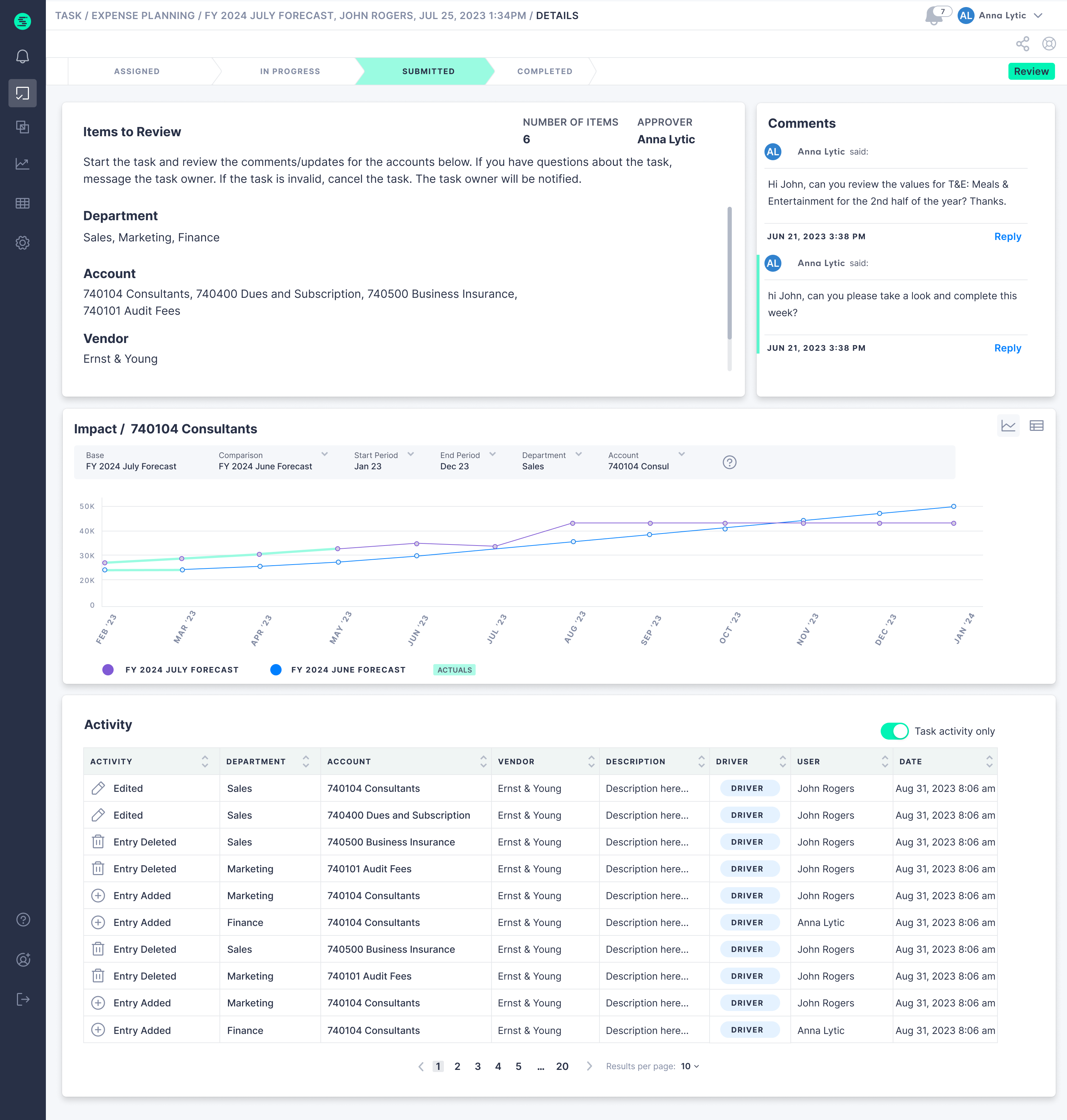
Expense planning grid — P&L owners enter department expenses directly in the interactive grid. Trended bar charts and KPIs provide context alongside raw numbers.
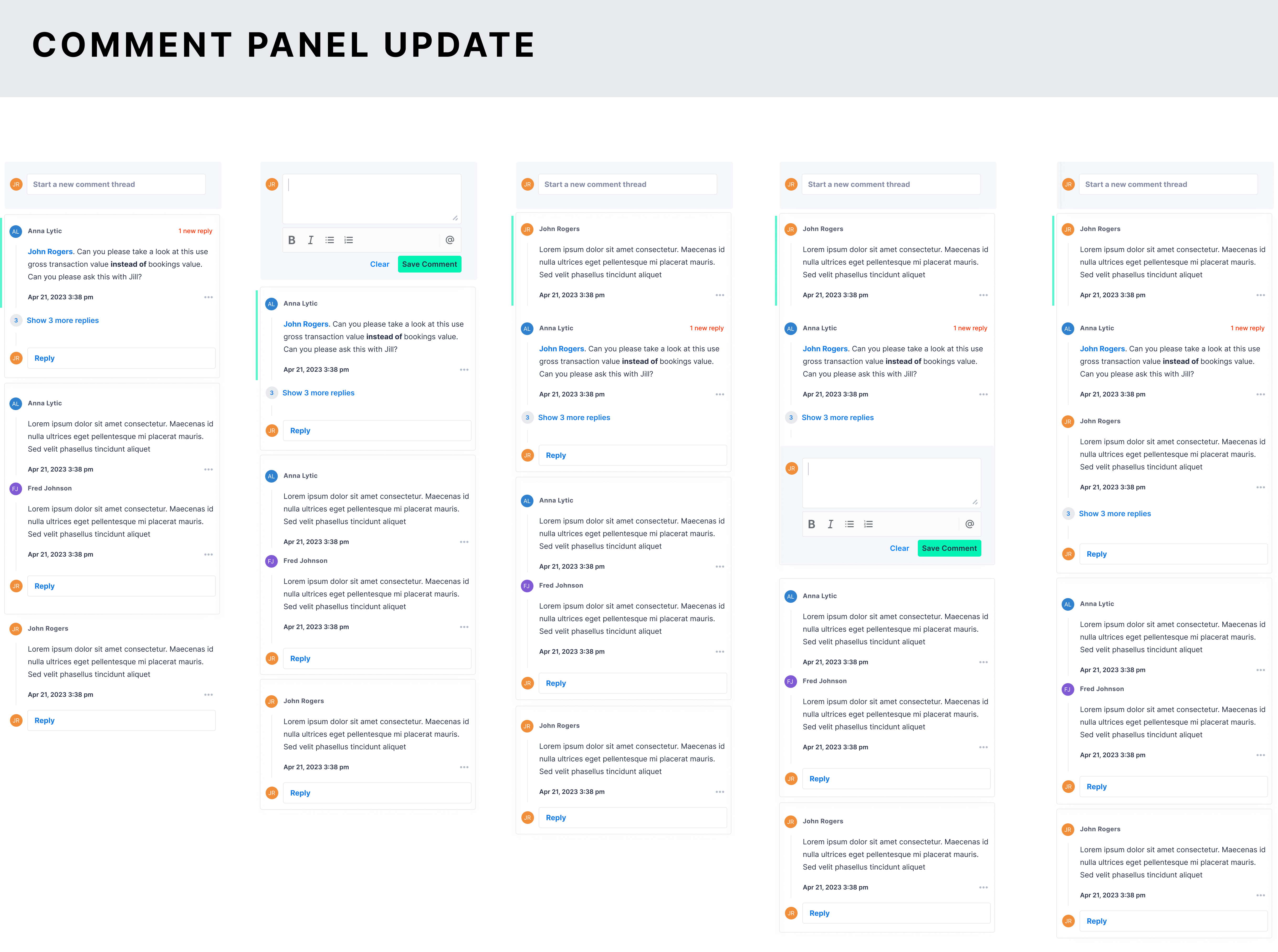
Threaded discussions — @mentions bring the right people into context-specific conversations attached to individual expense entries, replacing fragmented email chains.
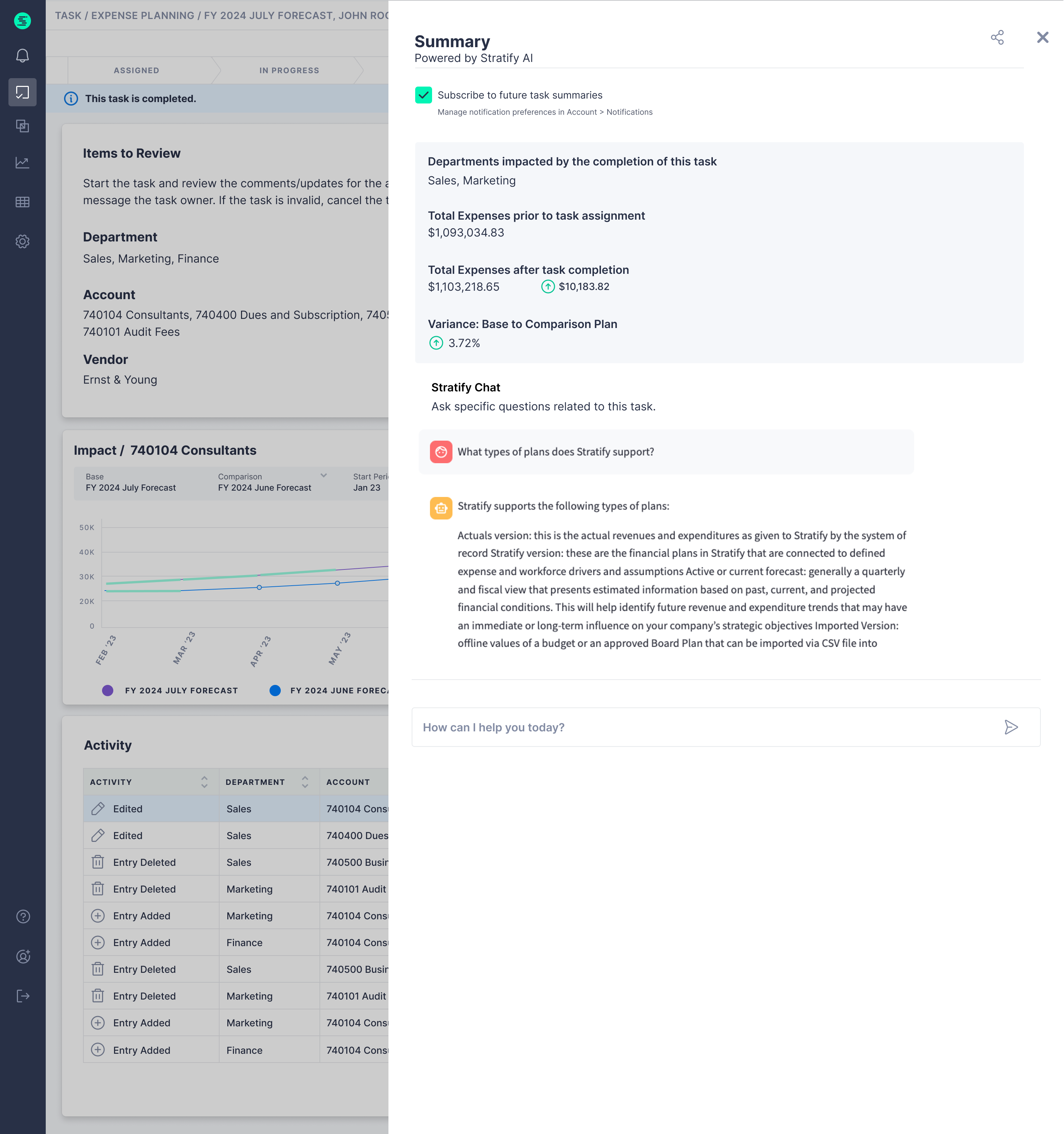
AI-assisted planning — Intelligent suggestions surface variance insights and anomalies, helping finance leaders review plans faster and with greater confidence.
Design System
PEAK: ~100 components built for financial interfaces
One of the most significant contributions of this project was the PEAK design system — a comprehensive component library built to support the entire Stratify platform, not just expense planning. PEAK enabled rapid, consistent development across a distributed team spanning Portland, Prague, and Romania.
Key components included AG Grid integration patterns, task workflow visualizations, notification and email templates, threaded discussion interfaces, approval workflow UI elements, data visualization components (bar charts, KPIs), and form validation states. The minimalist aesthetic was a deliberate design choice: reducing cognitive load for users working with inherently complex financial data.
I also led the frontend engineering team — not just designing, but prioritizing JIRA tickets, leading standups, and presenting at sprint demos. This dual role gave me direct influence over implementation quality and created a tight design-to-engineering loop that kept the product moving quickly.
Outcomes
100% adoption — no customer fell back to Excel
The results exceeded product-market fit benchmarks for enterprise software, where partial or reluctant feature adoption is common. Customer feedback validated the strategic bet on simplicity over cleverness.
"Stratify makes me more efficient. Now I have time to do more value-added work." — Customer
100% customer adoption
Every onboarded customer used collaborative expense planning through their full budgeting cycle — a significant departure from typical enterprise software adoption rates.
20–30 hours/month reclaimed
Finance teams redirected time from spreadsheet maintenance to strategic analysis — exactly the mission Stratify was built around.
Reduced plan errors
Plans were demonstrably more accurate than legacy spreadsheet processes — eliminating formula errors, version confusion, and conflicting numbers.
Key differentiator in sales
Collaborative planning became a cornerstone of Stratify's value proposition, contributing to the company's merger with Archway Software in December 2024.