Chris Rivard

Product Design & Mountains

Low-4

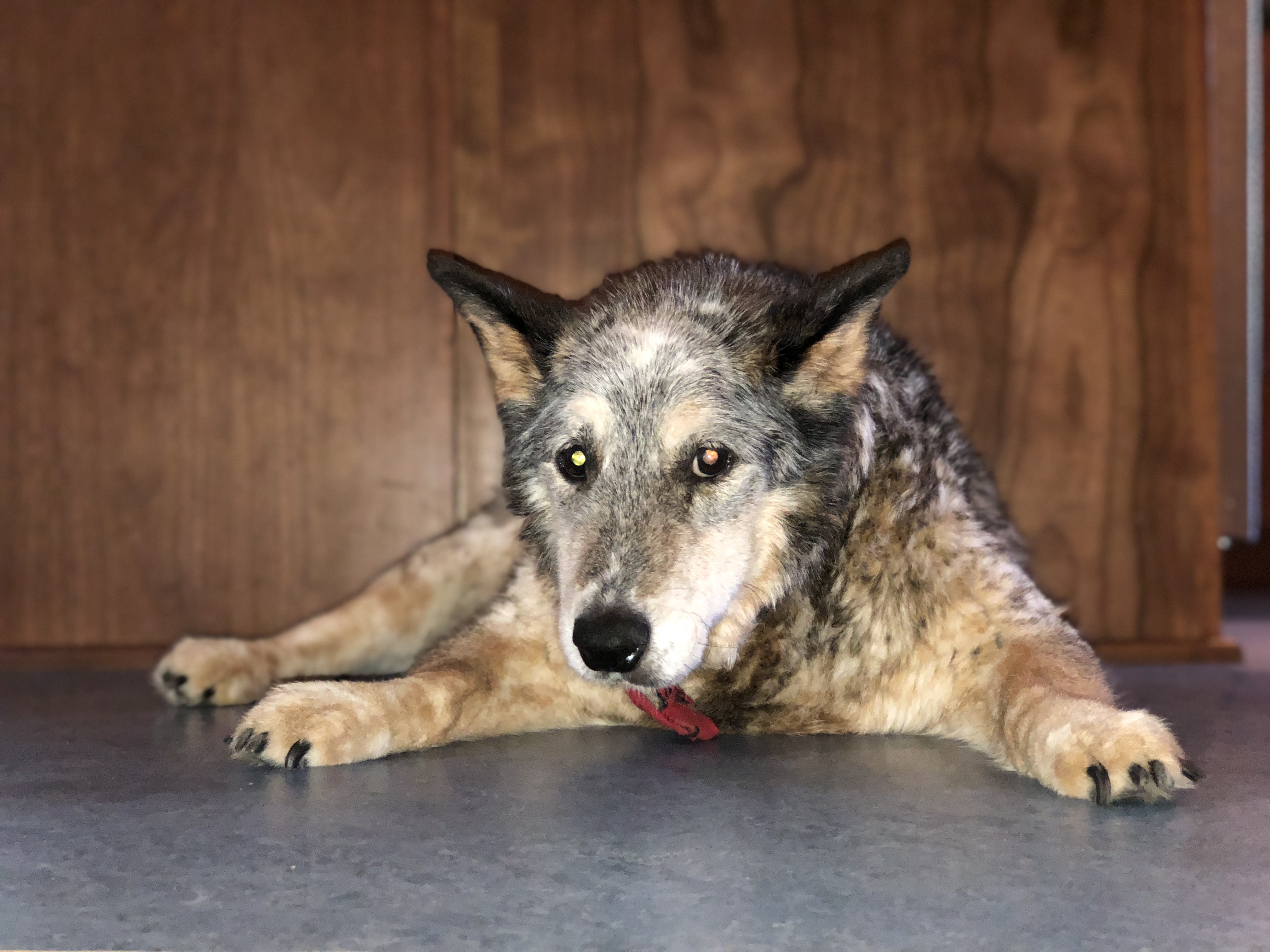
Alec gave him the nickname when we were hiking out of Chicago Basin in the Needles range, Colorado. His real name is Wonka. He and Granite Chief aka Chiefy, hiked with us from Purgatory Ski Resort just outside of Durango back into the range. We were headed back up to climb Mount Eolus and Sunlight Peak, one 14’er we climbed a couple of years earlier, one we hadn’t.

To understand how Wonka earned the nickname, it’s important to learn his personality. We adopted Wonka from Watermelon Mountain Ranch in Albuquerque. First he was a res dog. In New Mexico there are a lot of Native American reservations and on those reservations, there are dogs neither spayed nor neutered. The litters are large. Many of them are killed on the highways, some make it out to the shelters. Wonka was lucky. He was adopted by a family living in an apartment, where he then proceeded to bite one of the children and went back out for adoption. Then he joined our pack. 

He’s deaf. It’s common in Australian Cattle Dogs. He has a gunsight notch at the tip of his right ear that Chief gave to him when they were competing for daddy lap time. His tail was cropped as a puppy, too short. He’s sensitive where his tail is cropped and would prefer not to have anyone pet or scratch that area. Wonka will always choose a hard floor to a dog bed, he eats every meal as if it will be his last, he takes pleasure in the simple things.

Living with a deaf dog, you grow to understand their needs – staying in visual proximity, waving them over – making sure they know you’re nearby by stomping the floor to send a vibration they can feel. As a deaf herding dog, Wonka has adapted the ways he keeps track of us. He’ll lay across all entries/exits in order to ensure we have to move through him to leave a room. He’ll then get up and reposition himself to achieve the best vantage point.

Wonka is my wing man. We spend a lot of time together, in the evenings. I read with one hand and scratch his head with the other. He’s always got eyes on me. And I’ve always got his back. 

Low-4. Hiking out through the blowdowns and across scree slopes Wonka had one speed. On that trip he didn’t stop, 19 miles we powered on. Toward the end of the hike I relieved he and Chief of the packs holding their dog food and treats they were carrying. At my heels Wonka will follow me anywhere. 

Meditations

Some of my favorites from Marcus Aurelius’s Meditations (Gregory Hays translation).

At dawn, when you have trouble getting out of bed, tell yourself: “I have to go to work—as a human being. What do I have to complain of, if I’m going to do what I was born for—the things I was brought into the world to do? Or is this what I was created for? To huddle under the blankets and stay warm?” —But it’s nicer here.… So you were born to feel “nice”? Instead of doing things and experiencing them? Don’t you see the plants, the birds, the ants and spiders and bees going about their individual tasks, putting the world in order, as best they can? And you’re not willing to do your job as a human being? Why aren’t you running to do what your nature demands?

Not to feel exasperated, or defeated, or despondent because your days aren’t packed with wise and moral actions. But to get back up when you fail, to celebrate behaving like a human—however imperfectly—and fully embrace the pursuit that you’ve embarked

To watch the courses of the stars as if you revolved with them. To keep constantly in mind how the elements alter into one another. Thoughts like this wash off the mud of life below.

Everything that happens is either endurable or not. If it’s endurable, then endure it. Stop complaining. If it’s unendurable … then stop complaining. Your destruction will mean its end as well. Just remember: you can endure anything your mind can make endurable, by treating it as in your interest to do so. In your interest, or in your nature.

The Pythagoreans tell us to look at the stars at daybreak. To remind ourselves how they complete the tasks assigned them—always the same tasks, the same way. And their order, purity, nakedness. Stars wear no concealment.

It’s quite possible to be a good man without anyone realizing it. Remember that.

Warm start

I’ve been burning through my book list trying to bring it home toward the end of the year. I’ll post the big(er) list in early 2019. So far at the top of my list for fiction is Kakfa On The Shore by Murakami. His writing speaks to me in a deep way.

Sometimes fate is like a small sandstorm that keeps changing directions. You change direction but the sandstorm chases you. You turn again, but the storm adjusts. Over and over you play this out, like some ominous dance with death just before dawn. Why? Because this storm isn’t something that blew in from far away, something that has nothing to do with you. This storm is you. Something inside of you. So all you can do is give in to it, step right inside the storm, closing your eyes and plugging up your ears so the sand doesn’t get in, and walk through it, step by step. There’s no sun there, no moon, no direction, no sense of time. Just fine white sand swirling up into the sky like pulverized bones. That’s the kind of sandstorm you need to imagine.

Nonfiction so far has been Marty Cagan’s Inspired (2nd edition). Good product discovery strategy.


What Would I Change It To?

[youtube https://www.youtube.com/watch?v=_oxTi81Or84]

What Would I Change It To (Avicii, AlunaGeorge)

Skimo Race #1

I “raced” my first ski mountaineering race today at Ski Bowl as the first race in a 3 part series organized by The Mountain Shop. My main takeaway… it was really short. Less than 3 miles. I rested my legs over the weekend to be fresh, but running Council Crest (~7 miles) is more of a workout than I got today. I was hoping to feel the burn, but it was kinda mellow. I’m a little baffled and thinking through what happened.

I didn’t go out hammering … but started around mid-pack, there was some room to pass on the first skin up, an open Blue run, less room to pass once we hit the skin track up. I fudged a couple of the first kick turns, then got my rhythm back and had some really nicely executed, solid kick turns. The turn just before the track steepened and turned and opened into a boot pack was tricky. The boot pack was my favorite part of the course b/c I could just hammer. I used a Dynafit pack with a ski loop and shoulder hook – it was really nice to pop the skis off, drop them in the loop, hook them and hammer up. It’s funny – the boot pack was made by a Yeti. Maybe 18 inches between steps? Like stepping up to a small chair. [the best boot pack I’ve been in was on St. Helens a couple years ago – baby steps all the way up. ]

My skin to ski and ski to skin transitions suuuuucked. I’m using Volkl skis with the “skin pin ” so there’s a little pin that goes into the ski tip and then twists to lock the skin on – tail hook is standard.  I didn’t try beforehand or during to pull off the skins while still locked into the bindings – I’ll try later this season, but I’m not sure if it’s possible. I kept skins in the velcro pocket of my pack (reachable while the pack is in) but I still unclipped the waist belt to store or retrieve the skins. Not super efficient there – but I was okay making newb racing mistakes today. The ski run down (2 laps) was not too steep, but completely skied out with moguls everywhere – I picked my way down and didn’t ski hard. The people I passed on the skin up absolutely smoked me on the descent. I just didn’t race the mogul run. The final descent was a blue run and skied it faster.

Next time:

  • faster transitions (try to tear the hides with the skis on)
  • have a system for transitions and practice it
  • get out front earlier and make time on the skin/boot pack
  • ski more 😉

I was most worried about layering and regulating temperature,  but my setup was ace. I was a little cold on the first downhill when I didn’t add any layer, but I was right back into the ski to skin transition and warmed up again.  On the last (longer) descent to the finish, I put on a puffy and was perfect for the ski down.

Didn’t eat or drink anything (it was short), but carried a bottle. Overall a super-fun first race. A gentle introduction.

https://open.spotify.com/embed/track/4BiiDQtijdt0WdtiyIPhnO

2017 Book List

It’s easy to slow down toward the end of the year. In 2018 I’ll try to be more deliberate in front loading the first half of the year. Here is the list of books I read. I’d like to try and hit 52 books per year.

  1. When Breathe Becomes Air – Kalanathi
  2. Purity – Jonathan Franzen
  3. The Art of Grace, On Moving Well Through Life – Sarah Kaufman
  4. Barbarian Days: A Surfing Life – William Finnegan
  5. The Tower – Kelly Cordes
  6. Competing Against Luck – Clayton Christiansen
  7. Nothing is True and Everything is Possible
  8. Hooked – Nir Eyal
  9. The World Beyond Your Head – Matthew B. Crawford
  10. The Glass Cage (Nicholas Carr)
  11. Machine Learning for Designers – PDF
  12. Shock Doctrine: The Rise of Disaster Capitalism
  13. Thinking in Systems: A Primer, Donella Meadows
  14. How to Makes Sense of any Mess – Abby Covert
  15. Presence – Amy Cuddy
  16. Hillbilly Elegy: A memoir of a family and culture in crisis
  17. Quiet: The Power of Introverts, Susan Cain
  18. Service Design: From Insight to Implementation
  19. Radical Candor
  20. Strong Fathers, Strong Daughters
  21. The Second Machine Age (McAffe/Brynjolfsson)
  22. The Last Samurai – Helen DeWitt
  23. Ready Player One
  24. Blue Ocean Strategy
  25. Product Leadership
  26. Annihiliation
  27. What Got You Here Won’t Get You There – Goldsmith
  28. Sprint – Knapp (Google Ventures)
  29. Super Intelligence, Nick Bostrum

Best fiction book of 2017 (from this list) – Barbarian Days … or The Last Samurai. Both were great. I can’t decide.

Worst book of 2017 (from this list) – Competing Against Luck (fucking terrible)…but I powered through it.

Best nonfiction/work book of 2017 (from this list) – Thinking in Systems. I was surprised at how much I was able to glean from this little tome.

Grrrrrr…

Reading Superintelligence by Nick Bostrom. Either we’re already living in an simulation or it’s all bullshit. I’m unsure which it is. The book is mostly a philosophical overview of the point at which machine intelligence becomes  “conscious” and begins to optimize for whatever goal it has determined. This is the crux of the problem – how can humans seed machine intelligence so that the goal of the AI is beneficial … or in the least doesn’t optimize for a goal that destroys humanity. It’s not a science fiction book. Consider the IQ difference between the village idiot and Einstein. The difference is nominal. Now consider a machine with an intelligence that is 1000x Einstein. What does that even mean? What would it want to achieve? Terrifying.

When I’m feeling the weight of the world or push myself up a long climb while running, I growl. It’s a primitive queue to try harder. And I do.

I need to bounce over to some fiction. The nonfiction business books are making me grumpy. Maybe the next Annihilation book .  I finally cleaned up my Goodreads lists.

The list

Currently reading Blue Ocean Strategy. I have a relatively short collection of business strategy books I’d like to get through this year. So far this book is infinitely better than Competing Against Luck (fucking terrible). I’ve been mixing in some fiction to stay sane. Here are the last few with some quick commentary.

Radical Candor – extremely practical management book. Key takeaway: be direct + care personally.

Strong Fathers, Strong Daughters – Things to remember when raising daughters.

The Second Machine Age (McAffe/Brynjolfsson) – Hmmmm… not as bad as I thought it was going to be. Not terrible. It’s a position. Don’t be afraid of automation. Tempered message overall.  Recommend.

The Last Samurai (Helen DeWitt) – Easily made my list of top 10 books, shy of Infinite Jest, but still ground-breaking. So much complexity and nuance to consider. Highly recommend. I’ve found myself watching the Kurosawa segments on Every Frame a Painting after reading this book.

[youtube https://www.youtube.com/watch?v=doaQC-S8de8]

Ready Player One – quite the juxtaposition after the above book. Maybe an 8th grade reading level? Hard to get past the prose, but I did and enjoyed the world he created (while trying not to think too much about the dystopian setting).

On deck (since I might not be back for a while):

  • Inspired – Marty Cagan (might wait for the v2 in January)
  • The Hard Thing about Hard Things
  • Team of Rivals
  • The Captain Class
  • Blockchain Revolution

Last 2

Quiet:  The Power of Introverts (everyone likes a book about power, right?). Thumbs up. Good read.

Or you’re told that you’re “in your head too much,” a phrase that’s often deployed against the quiet and cerebral. Of course, there’s another word for such people: thinkers.

it’s only when you’re alone that you can engage in Deliberate Practice, which he has identified as the key to exceptional achievement. When you practice deliberately, you identify the tasks or knowledge that are just out of your reach, strive to upgrade your performance, monitor your progress, and revise accordingly.

Service Design: From Insight to Implementation

Tough read, but in the end very insightful and valuable in thinking about expanding the concept of a journey map. I felt the most interesting examples at the end of the book were about public service design. There is definitely a phase where the design of services overlaps with public policy and politics in general. Think of dark patterns in user experience and the design of services that purposefully extract money from a population. Health care is of course the ultimate service (that is best experiences when it’s not used, e.g. you’re healthy).

A useful way of thinking about people’s roles in services is to think of every exit “off stage” as an entrance somewhere else. This is particularly true in situations in which the staff involved in delivering the service are service users and service providers at the same time.

Do people understand the service—what the new service is or does? Do people see the value of the service in their life? Do people understand how to use it? Which touchpoints are central to providing the service? Are the visual elements of the service working? Does the language and terminology work? Which ideas do the experience prototype testers have for improvement?

typical service blueprint template, with the phases of the customer journey along the top (here it’s Aware, Join, Use, Develop, Leave) and the various touchpoint channels in rows underneath, including the backstage activities at the bottom. A couple of touchpoints have been filled in as examples.

Some examples of Service Design Blueprints.

Currently reading: Radical Candor

McDonald’s

Burned through Hillbilly Elegy in a few days.  I thought he did a great job of making the time period relatively abstract and focused more on the demographic, cultural and social implications of growing up in Kentucky/Ohio. There were few period references – the war in Iraq (I’m assuming the second one, not the first). Just a few pop culture references.

The thing that struck me was how much I related to some of his stories. Not so much the family dysfunction (some of that) but mostly just what it’s like to grow up poor. I remember my dad taking me to McDonald’s for my birthday -which was a huge deal. The kind of food that my family ate growing up (not super healthy). Just generally the class distinctions between rich and poor.

My dad was enlisted military, there were 4 kids in my family – there was never any money for anything. We went to church every Sunday and the special treat after church was getting donuts. Being a military brat, we lived on base in military housing until I was in middle school. Shopping was done at the commissary and the PX (post exchange). One of the extraordinary things that I realized later in life was how diverse my schoolmates were – enlisted families were mostly poor families: black, hispanic, asian, white. The common denominator was that our parents all worked for the same “company”. Without the structure of sports teams I’m not sure what we would have done. I think I played every sport offered by the DYA (I’m guessing that stood for the department of youth activities).

After moving off of base housing at Fort Benning, Georgia (where the School of the Americas was based) my parents sent all of us to private Catholic school, where my mom also taught.  I remember having the discussion of whether or not I wanted to go to the Columbus, GA public high school or Catholic school and I pleaded with my parents to go to private school. I remember the times that tuition was late or my mom was worried that we didn’t have the money to pay.  I was the first in my family to go to college.. that’s essentially where I split from the family — I started college on a studio art scholarship and then transferred into the University of Maryland in College Park.

There is definitely an age – around middle school / high school, where kids need the support to make the leap to jump out of their class. For me it was the decision to go to private school and my parents acquiescence.

The book is a best seller because he nails what it’s like growing up in Appalachia. There is a bit of a mixed message about abdicating personal responsibility and viewing everything as hopeless and stacked against your versus taking responsibility and pulling yourself up by your bootstraps. In his case his mawmaw (grandmother) was the person to put him on the right path.

In the last few chapters of the book as he moves from undergrad to law school – it’s interesting to read about his realization of the distinction between poor and rich. The things about how the world really works in upper / upper-middle class families. I won’t give it away – but it’s definitely worth a read.

On the broader socioeconomic side of where the author is coming from – Chris Arnade is doing amazing ethnographic research on Twitter.

Page 11 of 36

Powered by WordPress & Theme by Anders Norén