Product Design, Leadership, Mountains

Chris Rivard

Month: February 2017 Page 1 of 2

Some ML Notes

Supervised, Unsupervised, Semi-supervised, Reinforcement learning

  1. Supervised
  2. Supervised learning procedures are used in problems for which we
    can provide the system with example inputs as well as their corre‐
    sponding outputs and wish to induce an implicit approximation of
    the rules or function that governs these correlations.

    The kinds of problems that can be addressed by supervised learning procedures are generally divided into two categories: classification and regression problems.

    In a classification problem, the outputs relate to a set of discrete categories.
    For example, we may have an image of a handwritten character and
    wish to determine which of 26 possible letters it represents. In a
    regression problem, the outputs relate to a real-valued number. For
    example, based on a set of financial metrics and past performance
    data, we may try to guess the future price of a particular stock.

  3. Unsupervised
  4. Unsupervised learning procedures do not require a set of known out‐
    puts. Instead, the machine is tasked with finding internal patterns
    within the training examples. Procedures of this kind are “unsuper‐
    vised” in the sense that we do not explicitly indicate what the system
    should learn about. Instead, we provide a set of training examples
    that we believe contains internal patterns and leave it to the system
    to discover those patterns on its own.

    In general, unsupervised learning can provide assistance in our efforts to understand extremely complex systems whose internal patterns may be too
    complex for humans to discover on their own. Unsupervised learn‐
    ing can also be used to produce generative models…

  5. Semi-supervised
  6. Semi-supervised learning procedures use the automatic feature dis‐
    covery capabilities of unsupervised learning systems to improve the
    quality of predictions in a supervised learning problem. Instead of
    trying to correlate raw input data with the known outputs, the raw
    inputs are first interpreted by an unsupervised system. The unsuper‐
    vised system tries to discover internal patterns within the raw input
    data, removing some of the noise and helping to bring forward the
    most important or indicative features of the data. These distilled ver‐
    sions of the data are then handed over to a supervised learning
    model, which correlates the distilled inputs with their correspond‐
    ing outputs in order to produce a predictive model whose accuracy
    is generally far greater than that of a purely supervised learning system.

  7. Reinforcement learning
  8. Reinforcement learning procedures use rewards and punishments to
    shape the behavior of a system with respect to one or several specific
    goals. Unlike supervised and unsupervised learning systems, rein‐
    forcement learning systems are not generally trained on an existent
    dataset and instead learn primarily from the feedback they gather
    through performing actions and observing the consequences.

From Machine Learning for Designers

The Glass Cage, Carr

I’m a sucker for the larger historical contexts of technology and culture. This book didn’t disappoint. I’m finding these types of books, where the author takes a contemporary idea and does a bunch of research and then writes a book to be less interesting than books with original ideas that are then supported with research. In this light I think Matthew Crawford’s book (The World Beyond your Head) is bit more on point.

The ideas around autonomous vehicles in transportation were interesting – cars and airplanes. This is the hot topic in technology culture right now. I thought the book was weak in the exploration of automation of cognitive work – the medical records and legal professions. This is most likely due to there being a dearth of writing about loss of white collar jobs to automation… from memory I think the trader (human) in the example of electronic trading algorithms was the most interesting. Same concept in a different context (speed) was the example of warfighting. It made me think of an example where there could be a war/conflict between two nation states’ autonomous systems that could occur overnight and the result would be that the losing sides economy collapses the next day and no one would know what happened.

He never mentioned Metropolis for some reason.

I liked focus on ‘generative thinking”. I thought about the distinction between something like a VR environment, immersive and complete (according to the creator) and something like a command line game or even a board game where the environment and immersive aspect need to be filled in by the consumer/player – this is more of a co-creative exercise. This idea can be taken out to really any physical / virtual interaction. It’s the core idea that Carr returns to at the end of the book with a line from Robert Frost’s poem, Mowing:

The fact is the sweetest dream that labor knows.

We rarely look to poetry for instruction anymore, but here we see how a poet’s scrutiny of the world can be more subtle and discerning than a scientist’s. Frost understood the meaning of what we now call “flow” and the essence of what we now call “embodied cognition” long before psychologists and neurobiologists delivered the empirical evidence. His mower is not an airbrushed peasant, a romantic caricature. He’s a farmer, a man doing a hard job on a still, hot summer day. He’s not dreaming of “idle hours” or “easy gold.” His mind is on his work— the bodily rhythm of the cutting, the weight of the tool in his hands, the stalks piling up around him. He’s not seeking some greater truth beyond the work. The work is the truth.

It’s the cognitive work that humans do to fill in the blanks of reality. I think there’s some philisophical underpinning here but I don’t know what it is – maybe William James? or maybe Rihanna. Work work work.

The mental act of generation improves people’s ability to carry out activities that, as education researcher Britte Haugan Cheng has written, “require conceptual reasoning and requisite deeper cognitive processing.”

I think one of his main premises is that embodied cognition is what makes us human and when we relegate tasks to an autonomous system, we become “less human”. I’ve been falling into the cognitive bias lately of gravitating toward every automation news article lately and I’m beginning to see them as overhyped in general. There are definitely concrete economic indicators that automation is replacing many jobs, but I think in general the current frenzy is tapping into the deeply held fear of some kind of Skynet fiction.

Both complacency and bias seem to stem from limitations in our ability to pay attention. Our tendency toward complacency reveals how easily our concentration and awareness can fade when we’re not routinely called on to interact with our surroundings. Our propensity to be biased in evaluating and weighing information shows that our mind’s focus is selective and can easily be skewed by misplaced trust or even the appearance of seemingly helpful prompts. Both complacency and bias tend to become more severe as the quality and reliability of an automated system improve.

There has been quite a bit of discussion about Guaranteed Basic Income as a future possibility of automation. Carr doesn’t seem to think that’s a realistic possibility. I’m less critical. In this aspect, it think there could be market forces to fill the need to idle hours of people with massive amounts of free time. In fact I think there could be a new renaissance in arts and culture – this could be the new work that replaces the hours at a desk or in a factory.

There’s a callousness to such grandiose futurism. As history reminds us, high-flown rhetoric about using technology to liberate workers often masks a contempt for labor. It strains credulity to imagine today’s technology moguls, with their libertarian leanings and impatience with government, agreeing to the kind of vast wealth-redistribution scheme that would be necessary to fund the self-actualizing leisure-time pursuits of the jobless multitudes.

The “choose your own adventure” autonomous future that I found comforting was the idea of adaptive automation:

One of the most intriguing applications of the human-centered approach is adaptive automation. In adaptive systems, the computer is programmed to pay close attention to the person operating it. The division of labor between the software and the human operator is adjusted continually, depending on what’s happening at any given moment. When the computer senses that the operator has to perform a tricky maneuver, for example, it might take over all the other tasks. Freed from distractions, the operator can concentrate her full attention on the critical challenge. Under routine conditions, the computer might shift more tasks over to the operator, increasing her workload to ensure that she maintains her situational awareness and practices her skills. Putting the analytical capabilities of the computer to humanistic use, adaptive automation aims to keep the operator at the peak of the Yerkes-Dodson performance curve, preventing both cognitive overload and cognitive underload. DARPA, the Department of Defense laboratory that spearheaded the creation of the internet, is even working on developing “neuroergonomic” systems that, using various brain and body sensors, can “detect an individual’s cognitive state and then manipulate task parameters to overcome perceptual, attentional, and working memory bottlenecks.”23 Adaptive automation also holds promise for injecting a dose of humanity into the working relationships between people and computers. Some early users of the systems report that they feel as though they’re collaborating with a colleague rather than operating a machine.

I like that he named the last chapter Automation for the People, which I assume is a throwback to Automatic for the People. Probably the best R.E.M. album… and the best song from that album.

[spotify id=”spotify%3Auser%3Aclearwired%3Aplaylist%3A6GkKfYTvJZYYpHM90XMdY0″ width=”300″ height=”380″ /]

Parametricism, Patrik Schumacher

[youtube https://www.youtube.com/watch?v=15DwINKFOM4&w=560&h=315]

Designing Meaningful Data Products, Enterprise UX Conference

The talk I gave for the UXPin Enterprise UX virtual conference on February 15, 2017.

I had lots of fun talking about data and design!

[youtube https://www.youtube.com/watch?v=87unf3arRAc]

100 things to remember

Found this in my notes last night. It’s the list of things that I wanted to remember when I ran Mountain Lakes 100.

Tips I picked up from reading a lot of articles and from reading Jason Koop’s book, Training Essentials for Ultrarunning. I highly recommend that book and if there’s one thing that I took away from it — it’s that you want to show up at the start line as FIT as possible. That means having your engine / Vo2max as high as possible — which means, do a lot of threshold training — which means — run a lot of hill intervals.

The other book that I recommend is by Matt Fitzgerald, How Bad to you Want It?  There was some pseudoscience-y bullshit in there, but for the most part it was inspiring to read anecdotes about the mental side of endurance racing. And running an ultra is 99% mental.

Here’s my list.

Goals
  • Finish the race (there’s nuance to this one – it’s not, “JUST finish the race” or “TRY to finish the race”, it’s explicit and direct:  “finish the m’fing race”)
Process Goals (how are you going to do this?)
  • Pacing
    • Easy the first 25 miles. Walk.
    • Refresh at 50 miles at Clackamas
    • Run as far as I can
    • Walk/run, shuffle to get back into running form, then run
    • Slow down when eating, then run when I have energy
    • Maintain a consistent pace (slow and steady)
  • Nutrition
    • Eat when my alarm goes off, every 20 minutes after 1.5 hours
    • Eat 200+ calories per hour
    • Try to eat as much real food as I can stomach
  • Attitude
    • Take care of problems in a deliberate way, don’t let them go
    • Say please and thank you.
    • Have fun and enjoy the long run! Force the smile.
    • Recognize the pain, sit with it and then let it go
    • Your heart must be large
    • Steer clear of negative energy people
ADAPT
  • Accept
  • Diagnose
  • Analyze
  • Plan
  • Take Action
REMEMBER
  • Keep focusing on the positive. No matter how bad things are, it could be worse.
  • Keep shuffling, even if it seems just as slow as walking. It’s not.
  • You want this BAD.
  • This is a meditation exercise
  • This is your treat!
  • Run the plan, run your race.
  • Keep it together. You got this.
  • You are an unstoppable force.
  • slow is smooth and smooth is fast
  • Steady and strong, steady and smart.
  • Be patient, no stress. Aid station to aid station.
  • If I stop now, I’ll soon be back to where I started. And when I started I was desperately wishing to be where I am now.
  • You didn’t come this far only to come this far.
  • I’m a tough MF’er.
  • Om mani padme hum.
  • Just flow
  • I don’t stop when I’m tired, I stop when I’m done.
  • Absolutely nothing hurts more than quitting would. Barring an injury that physically prevents me from making forward progress, I’m not going to stop until I finish this race.
  • I will do all that I can do, and a little more.
  • During the first 50 miles don’t be stupid, during the last 50 miles don’t be a wimp.
  • Have faith that the low point will not last. Everyone gets out of it eventually.
  • Expect a very dark point about every 20 miles, or every 5 – 6 hours. Count the dark points, and make a pact to push through at least 5 of them.
  • I CAN do this, I WILL finish
  • Clear Your Mind of Can’t

Don’t forget to smile.

Pocket + Read Ruler

I decided to get organized and stop dropping everything (links, notes, images, ideas) into Evernote (my distributed cognition 2nd brain) so I decided to try Pocket.

I don’t like that I’m locked into Pocket and can only share links with friends through a Pocket url. Super annoying.

https://getpocket.com
With the browser plugin to save articles to Pocket. The thing I found lacking was the absence of a ‘time to read’ estimate.

http://readruler.com/
To provide an estimate for how long an article is going to take to read.

The time to read is key for those limited times throughout the day when I have a few spare minutes to read a short article in my list.

I thought this article was helpful in thinking about how to read all those books in the backlog.

https://medium.com/@kennethn/how-i-read-more-books-13c2357a96a3#.e4vflefwl

The hook

Good read following Hooked and The World Beyond your Head. Same topics but dialing in on choice architecture and variable rewards.

How Technology Hijacks People’s Minds — from a Magician and Google’s Design Ethicist

The takeaway is to always consider (when presented with a fixed set of choices, options, menu items) what is not in the list and why. This gets to the core of choice architecture … unless of course you’re the one making the list of choices.

Notes from books

Not that I’ve looked very hard, but I haven’t found a good way to get to the highlights I make in the books I read on the Kindle. In Crawford’s book, I took pictures within a note in Evernote and let Evernote handle the OCR scan.  Then I simply exported and cropped the images. A bit too time-consuming.

Well I looked in my Amazon account and found my notes this morning!

Here are some choice highlights from some 2016 books.

From The Art of Grace:

  1. 1. Slow down and plan. There’s no way to be graceful when you’re rushing around haphazardly.
  2. 2. Practice tolerance and compassion. This goes along with slowing down. Take time to listen and understand.
  3. 3. Make room for others—on the sidewalk, at the bus stop, in a coffee shop, during a business meeting, and in your life.
  4. 4. Strive to make things easy for people, even in small ways.
  5. 5. Make things easy for yourself. Be easily pleased. Accept compliments, take a seat on the bus if someone offers it to you, embrace any kindness that comes your way. This is graciousness, and it is a gift for someone else. You are giving another person the gift of being graceful.
  6. 6. Lighten your load. Shed painful shoes, disencumber yourself of heavy purses, backpacks, and briefcases. Let the bad stuff go, physically and emotionally.
  7. 7. Take care of your body. The more you move, the better you’ll move. And the better you’ll feel.
  8. 8. Practice extreme noticing. Look for grace where you least expect it.
  9. 9. Be generous. It’s a lovely thing to anticipate and fulfill someone’s hopes.
  10. 10. Enjoy. Raise a glass, as Lionel Barrymore did in the movie Grand Hotel, “to our magnificent, brief, dangerous life—and the courage to live it!”

From When Breathe Becomes Air:

Moral duty has weight, things that have weight have gravity, and so the duty to bear mortal responsibility pulled me back into the operating room.

From Purity: A Novel:

She proceeded to cry torrentially. The only way I could get her to stop was to become, right then and there, a person who experienced as keenly as she did the unfairness of my being able to pee standing up. I made this adjustment to my personality—and a hundred others like it in our early months together—and henceforth I peed sitting down whenever she could hear me. (When she couldn’t, though, I peed in her sink. The part of me that did this was the part that ultimately ruined us and saved me.)

From Training Essentials for Ultrarunning:

Successful outcome goals strike a balance between being achievable and offering a challenge. Where you sit on the achievability teeter-totter depends on your individual tolerance for risk. As you set goals that are more challenging and closer to the limits of your capabilities, you must simultaneously accept a higher level of risk associated with those goals. The inverse is also true, but sometimes it’s harder to grasp. Goals beyond your physical capabilities are not well-constructed goals. It is also important to realize that if you have a low tolerance for risk, an extremely challenging goal is just as inappropriate as a goal that is way beyond your physical capabilities.

Earfood (3)

[spotify id=”spotify%3Auser%3Aclearwired%3Aplaylist%3A1aySrBEZs9JbZ9c6X37DOH” width=”300″ height=”380″ /]

Take me to the River

The World Beyond Your Head: On Becoming an Individual in the Age of Distraction, Matthew B. Crawford

Crawford’s starting position is that beginning in the Enlightenment there has been a push for the “individualism” as defined by Kant’s “rational human”, and “freedom” from the monarchy, the government, any outside influence in fact. The author’s argument is that this mode of thinking is both anachronistic and detrimental the modern world in which we find ourselves situated.

We are finding ourselves more ostracized from both our communities and from the physical world.  At the same time, we’re expected to be hyper-responsible for our individual decisions as defined in a Libertarian political philosophy.  Given this position of “rational human” we’re left to make decisions in a sort of vacuum, separated from both culture and context. This leaves our lives (private and public) open to choice architects and consumer capitalism.

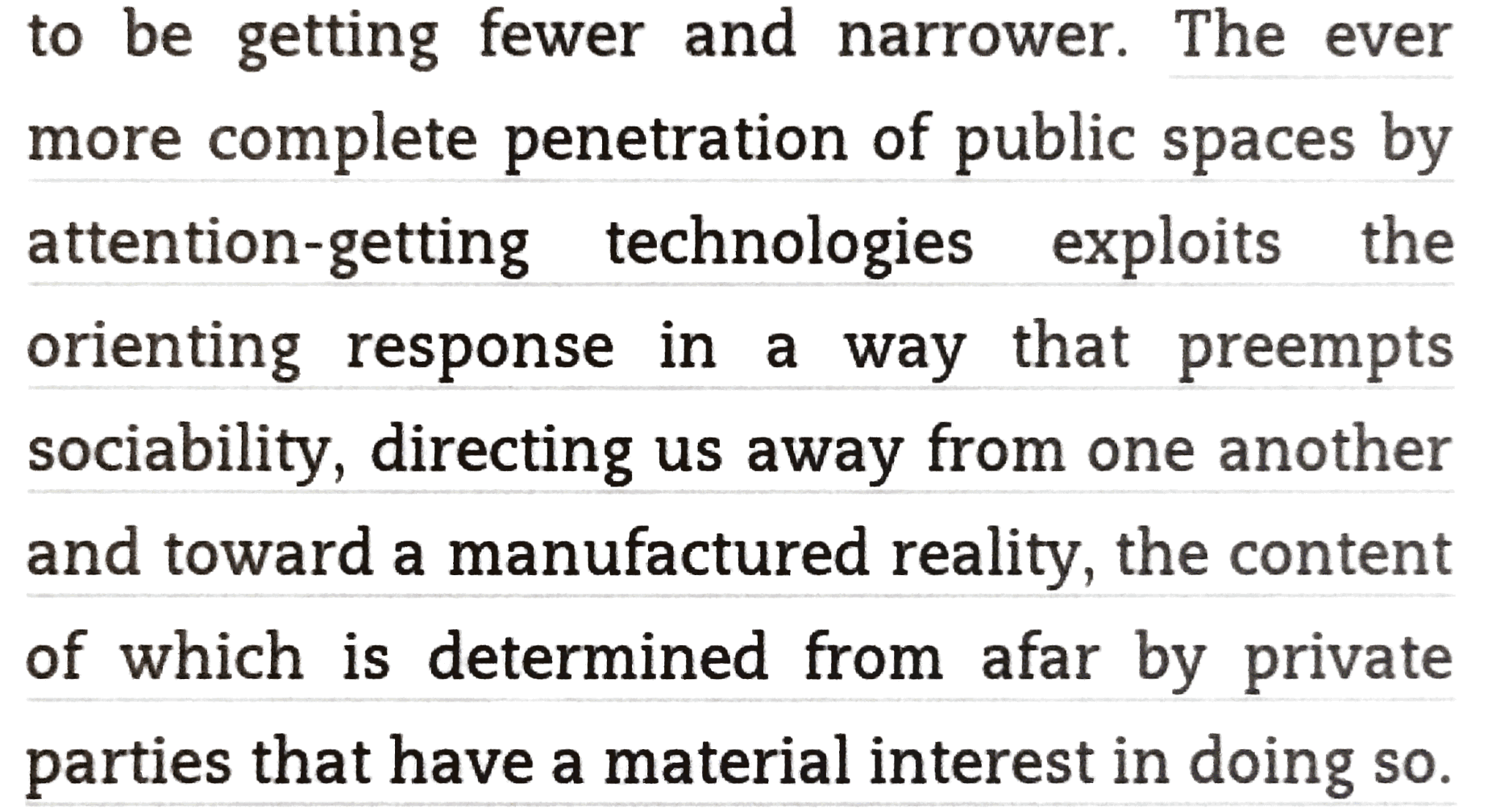
Choice architects create experiences to fill the void left when we have no opinion, or choose not to directly engage the physical world. No one explicitly argued we should not have advertisements in the bottom of luggage trays when going through security at the airport. I think this is commonly called the reduction of “the commons”. Public space is becoming more saturated by choice architects whose interests align with corporate entities, not the public.

After reading Hooked (Nir Eyal) about the design of addictive products, this is the disruptive world of technology we live in. It has been said that we didn’t get flying cars to take us through a physical space, we got the instantaneous variability of a Twitter or Instagram feed that satisfies deeply psychological appetites.

The author makes the distinction between a tool using human –  the hockey player whose stick becomes an extension of his body or the motorcyclist who can feel the variations of traction, gravity and … vs. a person playing a video game who is learning only to press a button to get the exact same response/reaction. The direct feedback provides no context between the action and response. We understand the world around us by interacting with it – it informs our reality. The real world is our best model says the author.

The most extreme example in the book is of gamblers playing electronic slot machines and the evolution of the gambling industry.  These games are purposefully designed to drive players to ‘play to extinction’, effectively using gamblers as a financial resource to extract money and then discard. The games are designed for addiction.

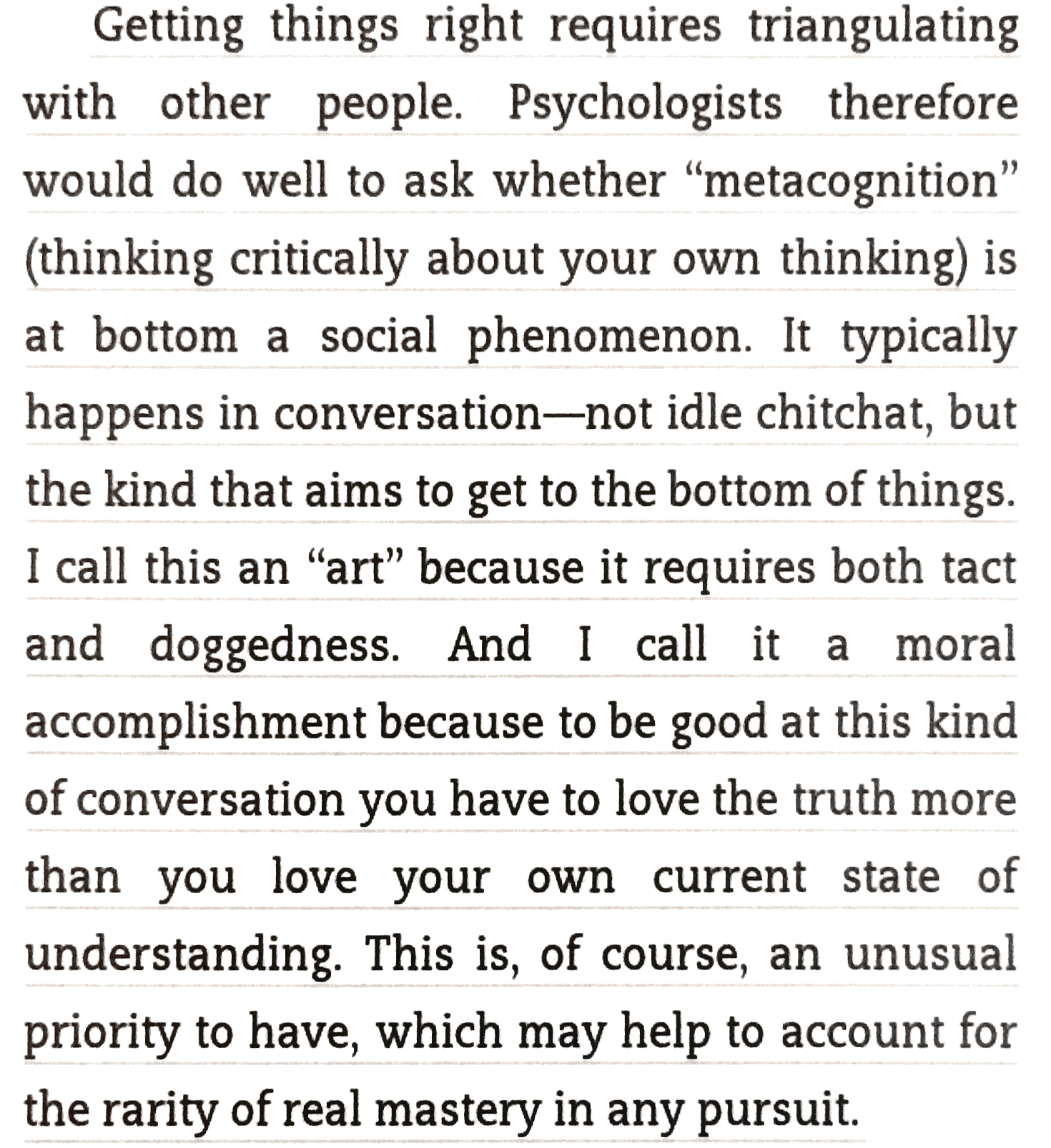
The author is addresses how deeply we hold on to our beliefs and succumb to our cognitive biases. It takes real work to first step outside of our perspective to see a new perspective, and even greater effort to then engage with another person in conversation to reach a shared understanding. David Foster Wallace speaks about this problem in his commencement speech at Kenyon College in 2005. Crawford argues it’s not enough to simply have empathy for our co-passengers but to actively begin a conversation and attempt to reach a shared understanding. I’ve always thought that speech was the pinnacle of DFW’s philosophy, and had never read a counter-argument until now.

There are types of interactions that foster this communication, Crawford uses examples from highly skilled physical work to highlight both the attentional focus and the conversation that occurs when communities of individuals are highly skilled and focused on a shared task. He uses as an example the distinction between learning in a vacuum, explicit book knowledge for example, and the tacit learning that comes about from an apprenticeship model.

One of the precursors of advances in the scientific community  in the 1950’s in the U.S. was the emigration of scientists after World War 2. They brought with them the tacit knowledge of “how to science” vs. what we see in other countries (China) that lack the ability to innovate quickly. Crawford posits this is based on a more flexible model than simply explicit rule-following

Interestingly in technology circles (and software product design), we talk about this idea of magic. “If the product could do anything, even something magical, what would it do?” I’ve posed this question numerous times in design research sessions. The goal is to find out what the customer considers a magical feature and then work backwards to the possible and begin to shape the product that will be designed.

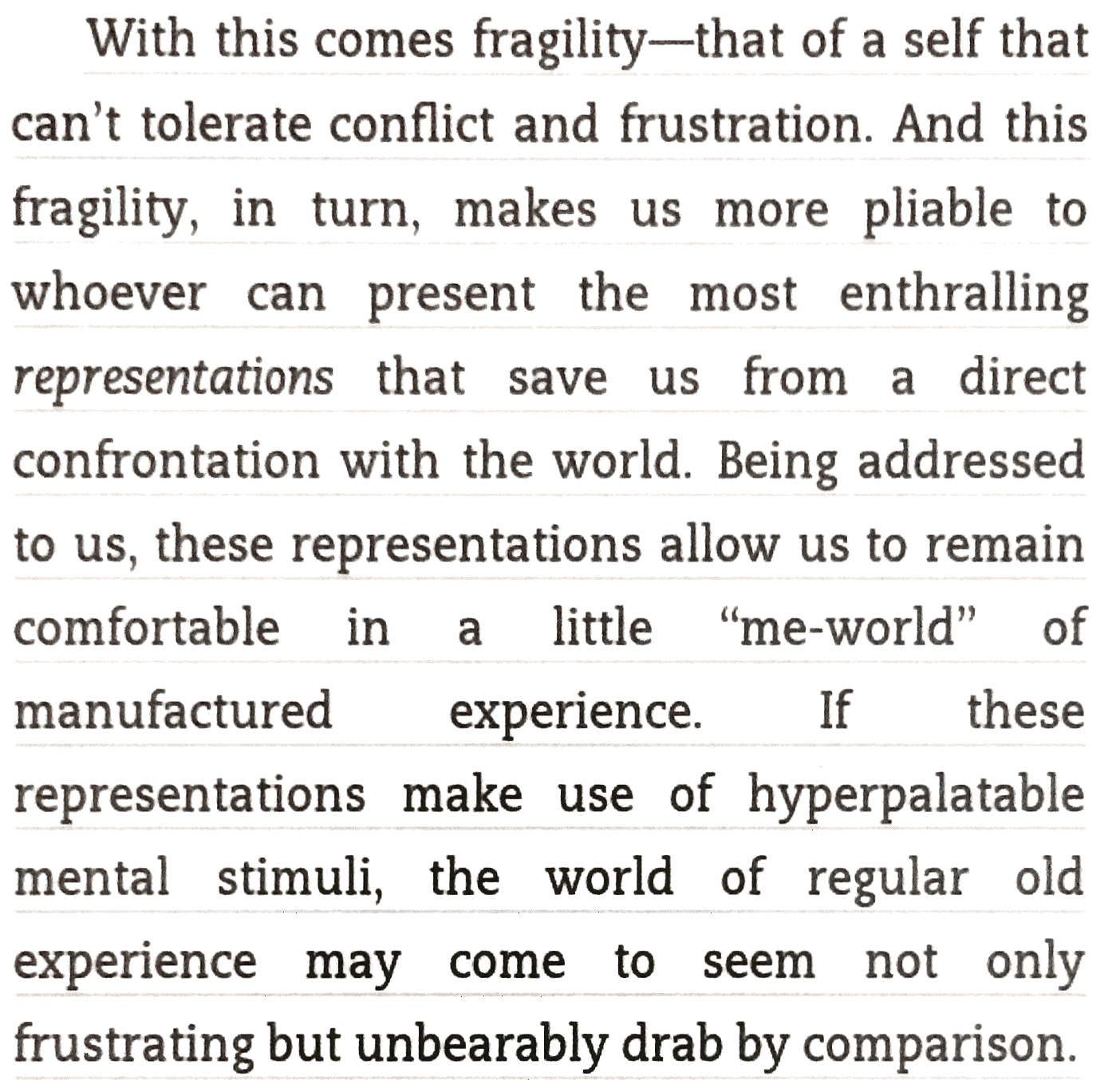
What Crawford is highlighting here is the lack of grounding with the physical world we inhabit with the technology that is becoming ubiquitous. The separation of direction action (agency) from the system response from a click. His argument is that we’re losing our sense-making abilities. An example he provides is of a motorcycle racer feeling the way the machine is interfacing with the road through sight, feel, sound and the lack of sensory insight (the obfuscation of) sensory input in something like electronic braking in a car. We are putting software interfaces between our physical senses and the natural world.

“Any sufficiently advanced technology is indistinguishable from magic.” Arthur C. Clarke

Is introducing magic (through technology) in our day to day lives a good thing? Where do we begin to separate from direct manipulation of the physical world. Virtual Reality is a good example here.

The Handy Dandy machine Crawford uses as an example is a Disney invention in current Disney clubhouse cartoons. He’s making the distinction from the physical comedy of old cartoons (where Mickey was beset upon by flying brooms, cast iron pans, etc and the new cartoons where kids are prompted to make a magical choice not grounded in any physical reality). The choice architects have limited what is the possible.

There is a passive interaction going on here – our frustration with reality rises and we sink into the instantaneous feedback loops of digital products.

This is the ubiquitous world of computing we’re inhabiting today. Any piece of knowledge in the world at our fingertips (or ears via a personal assistant like Alexa, Siri or Google Home). There seems to be a “compression” occurring – we are more able to locate and recall information thus expanding our capacity, but we’re losing the context of why the information is important in the world.

We can escape from the physical world into the information space that’s all around us. Crawford describes this arrangement as a new form of autism. People disengaging with the physical world and retreating to information spaces.

Reading this book following Hooked (and being a professional designer) really drives home the questions of ethics of product design (and experience design). What are we actually designing? To what end? What is the value of an experience in the real world?  What is the value of mastering a skill that doesn’t involve the ability to click a button or manipulate a digital interface?

Ultimately the author presents the concept of “ecologies of attention”. Shared experiences of skilled practitioners creating value tied directly to the physical world.

Hipsters explained.

In order to take back our attention, we need to create ‘ecologies of attention’ that provide direct feedback to the physical, not the virtual world.  I love the idea, but it feels like the train has already left  the station. So where do we go from here?

In the design of software products, I think a balance can be found in providing information and designing interactions that ground the user in the concrete. The concrete being a relatable context the user can comprehend.

Finally, it’s helpful to understand the lineage of philosophy, economics and technology from the Enlightenment to the present in order to better understand why it feels so unnatural to immerse ourselves in technology and to better establish a position for how to think about how we think (meta cognition) about ourselves in the technology revolution in which we find ourselves.

More could be said about the value of a liberal arts education or the value of mastering a skill… but I’ll stop here.

For reference:

Nir Eyal – Hooked
David Foster Wallace’s Commencement Speech

Page 1 of 2

Powered by WordPress & Theme by Anders Norén