Product Design, Leadership, Mountains

Chris Rivard

Month: January 2014 Page 1 of 3

People

In 2008 after I turned off the lights at Clearwired I always used to say that the hardest part of the job was managing people. Brutally hard. I don’t talk much about what running a company was like. Most people with the entrepreneurial dream have no idea what they’re getting themselves into. Someone wrote recently that all those people who talk about failing fast and starting again – have never really failed. If they had, they wouldn’t be so quick to do it again. Tru dat.

There is the force multiplier aspect of management, if you can get a team properly tuned (to each other, to the work), but there is also the emotional work that goes into finding out how people are really doing.

“How are YOU doing?” “How is your life?”

Highs and lows, hopes and dreams, expectations for the future. What motivates and demotivates. People spend more time with colleagues at the office than with their spouses and families in some cases. I’m not saying that’s right or wrong, but in some cases it happens. People are unpredictable. The problems faced as a working designer pale in comparison.  It’s one of the reasons that I returned to an IC role.

I’ve had people tell me management is easy (those people were shitty managers  but didn’t know it).

I didn’t run today because I was doing manager work. And I was exhausted.


How was your run honey?

http://www.strava.com/activities/110036977

Screen Shot 2014-01-30 at 7.08.42 PM

Well…it was a little weird.

My nutrition was off today (and yesterday). I think it’s  the pace of work right now (lots of morning meetings). This is pushing my 2nd breakfast out later than normal, causing blood to go to my stomach for digestion when I’m leaving to run. This in turn is making me feel really slow at the start of my run – the first 3 miles today. Ugh. (And we all know it’s not socially acceptable to bring a food bag into a meeting and just eat the entire time…unfortunately).

In reality, those miles weren’t that slow, they just felt like it.

I’ve run 3 times now since the bionic eye procedure – and kept sunglasses (yellow lenses) on for the first 2 runs. Today, with the temperature and the up – they were just fogging and I decided to pull them off.  Much better.

I took the SJ Ultra vest out for the first time today. Really just to see how it felt – I typically don’t carry anything on runs shorter than 10 miles – just a key and my iPad shuffle.

Today I carried :

  • one full bottle in the front right chest holster – just water
  • 4 Clif shots
  • 1 Pedialyte ss mix packet
  • 2 gatorade ss mix packets
  • a fleece hat
  • my Go-Lite shell (windbreaker)

Everything rode very smoothly. I was worried I would get a lot of bounce from the water bottle, but that wasn’t the case.  The load stayed balanced and I barely noticed it was there.  I did have music in, so I didn’t hear any water sloshing – which is a common complaint.

My only issue is with the nipple on the Ultimate Directions bottles – the suck. Literally. You have to pull the nipple out and then it has a valve inside that has to be compressed before water will flow…if I have to write a sentence describing how to drink water from a bottle – the design is flawed. I’ll use non UD bottles from now on. Or my old UD’s without the weird nipple. Nipple.
Screen Shot 2014-01-30 at 7.50.38 PM

No chafing, no bounce – lots of storage and it carried very well.  The sizing is tricky (as many people state in other reviews).

My favorite section of this run is …. well I have 2 actually.  The first is after you cross the road descending from Pittock Mansion. Smooth with wide switchbacks – easy to run fast on not too steep a grade. And the other is ascending through Hoyt Arboretum – I had no idea there were giant sequoias in Forest Park. It’s amazingly beautiful – ferns, spruce, sequoias. Nice trail too.

hoyt
Those sequoias are down the hill to the right… my running direction is up the hill to the left… of course.


Full Value Day

The morning starts like this:
http://www.strava.com/activities/109587760

Then lunch (tons of meetings today, so second breakfast/lunch was too late):
http://www.strava.com/activities/109619949

And then home again:
http://www.strava.com/activities/109676711

I call it a full value day – it’s usually about 15 – 20 miles of human powered activity. I feel most human when I can get this kind of mileage in.  A longer lunch run is a bonus, but generally means more calories in throughout the rest of the afternoon.

Meet el Mundo.

elmundoEl Jefe

This my daily driver – essentially the SUV of bikes. It’s a v4 Yuba Mundo frame, Surly Big Dummy fork,  Avid BB7’s front and rear. It weighs about 70 pounds dry (sans panniers). I built it 3 years ago.

Sometimes I think about adding an electric wheel assist and battery… but then it wouldn’t really be a bicycle any longer. I prefer the workout of pushing this thing home and riding it like a freight train into downtown every day.

I considered an adventure worthy of my time last spring – and never found the time.  Strapping the skis onto el Mundo, riding up to Timberline, skinning as far as I can, climbing Mt. Hood, skiing back down and then riding back home to Portland. It’s been done before – nothing new. Perhaps Perhaps Perhaps.

[youtube https://www.youtube.com/watch?v=HWgUBFOCxB0]

I spy.

From council crest.

photo-(3)

Human (again)

http://www.strava.com/activities/109151569
First run after bionic eye procedure.

Took it super slow and and tried to be really smooth (as not to jostle anything loose).

Minor freak-out when I started to warm up and my sunglasses began to fog and I thought that my corneas were detaching (oh f**k!). I think everything is pretty well glued down at this point though.

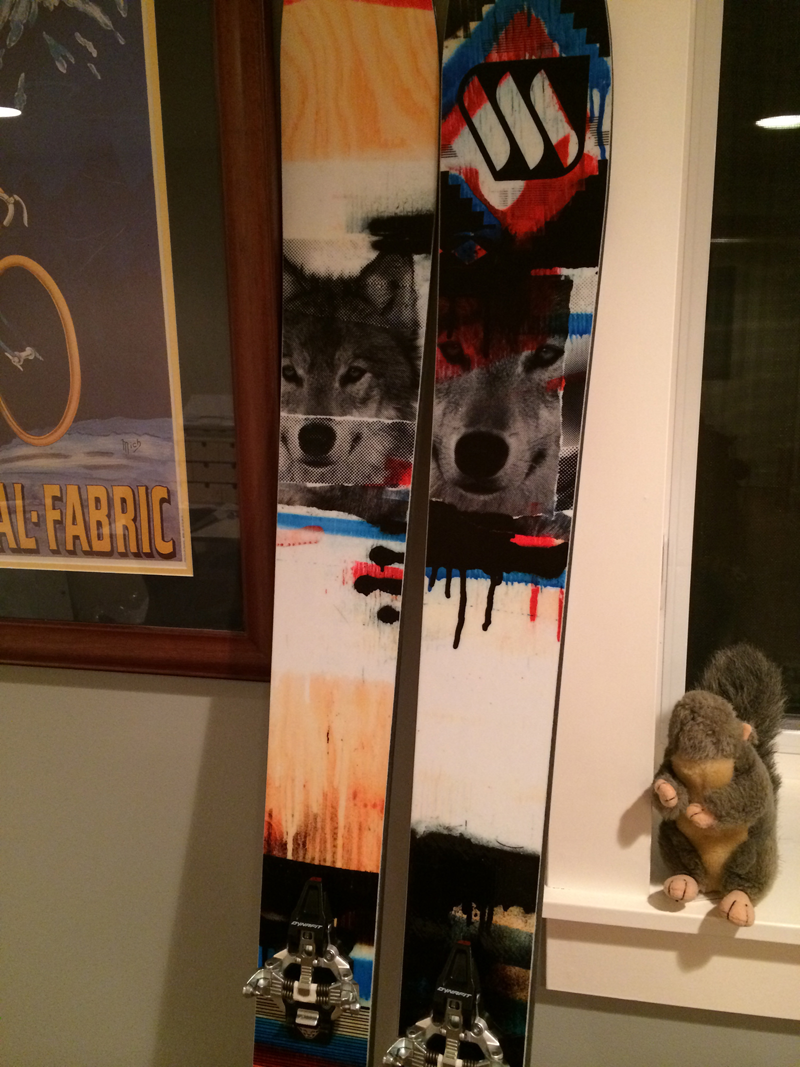
My skis are sitting in the closet …just waiting and waiting… and they’re very sad. My pack is packed and ready to go…climbing clothes are hanging in the closet…ready. Crampons are filed. Alpine rack is packed.

theboysThese boys are very anxious.

Started to get  really grumpy yesterday about the horrible snow conditions, finding time to go climbing, etc. etc.  My long runs were satisfying the urge to get out get into that mental state, so sitting around in sunglasses staring at the ceiling last week nearly drove me insane. The weather this year is *not cool*. It was sunny and nearly 50 degrees today. It reminds me more of a New Mexico or Colorado winter (but warmer). Cold and sunny. I miss it, but in the PNW – I want big dumps.

To be static – it’s torture. An object in motion tends to stay in motion. Never stop moving. I live by it, set my clock to it.

I’ll probably carve a midnight to 10am skin/climb up Hood soon. From what I’ve read in recent trip reports, the mountain above Palmer glacier is all ice and most people are ditching skis at the Palmer lift and climbing the rest of the way.  So it goes. Good for crampons, bad for skis.

Glad to be running again – I’ll resume normal operations this week – maybe take some eye drops with me if my eyes get dry on a longer run. I’m back and open for business.


Make it awesome.

(Step back everyone, I’m going to talk about design.)

I actually prefer, “Make me care.”  Which is found in the poster I have at my desk. (I hide when the kiddos come around the office during the holidays.)

The answer to the question, “why should I care?” should be infused into any design. Sometimes it’s evident in the solution – but oftentimes, it’s a great fundamental question to continually ask. I think it keeps designers honest and focuses efforts on the big picture.

Continuing this line of thinking leads to, “make it awesome”. Which is one way of ensuring your design is novel, innovative, *simple*, etc. But I think there is another meaning to make it awesome – a more subjective definition. The question is this:

Does the design problem meet the designers expectation of what they should be designing? Is the design problem a good match for the designer? Does the designer feel that the design problem is worth designing for? And can they make it awesome to their standard? (which may be pretty damn high).

This line of thinking has followed from my position that where you allocate your time and attention defines what you find important.  Why should you design a solution for a problem that cannot meet your standard? Why should you not spend your time on (activities) that meet your standard.  I think this is true across pursuits, whether they are athletic, scholarly, artistic…  there should be a standard of engagement with anything you decide to pursue, and that standard should meet or exceed your expectation.

Regarding reality. There is aspiration and there is reality. Moon shots always. Reality will be your guide, results will be your guide. But to resign yourself to a low aspiration and never meet your expectation… could lead to a life of regrets.

Lastly – and this is where everything I just wrote goes out the window. Sometimes the process of determining your standard of what awesome is… and matching a design solution to a problem that meets your expectation… well – sometimes this *is* the design problem.  The Big Design problem.

  1. Make me care
  2. Make it awesome

If you can’t answer the first and do the second, rethink what you’re doing.

Portlandia

A colleague has a place in the big tower in the west end with the wind turbines up top. Apparently the turbines control the elevator lift… (not really).

photo (2)

[youtube https://www.youtube.com/watch?v=orRMxdLgAxk]

Reading

So I posted the reading list last week, but I had forgotten that I received Creative Confidence for Christmas (hard copy). I’m always wary of things that will “unleash” something… and I’m about halfway through the first chapter and there has already been the anecdote about regular Joe “unleashing” creativity in his corporate soul-sucking workplace.

I’m kind of thinking I might not be the target audience. Feels like one of those airplane reading business books. I like my business books trashy. This one seems like it’s going to be buttoned-up, no-nonsense. And really try to provide 7…make that 10 steps of instruction to the dear reader so they might UNLEASH the creative KRAKEN on their co-workers.

photo (1)

My review thus far:

It’s a well-made book showing heavy duty stitching at the spine.  The paper must be 20# and beautifully glossy. The pages shine. The producer of this book knows quality publishing. The dust jacket is a plasticized material – like Tyvek, but smoother.

This book could hold down a stack of weekly NYTimes print edition newspapers in a 10 knot breeze with aplomb.

It is about the size of my iPad mini, but heavier. There is a certain gravitas to this tome. I suspect that it’s going to be about empathy and human-centered design. Just a hunch.  I’ll report back.


Race results

28th overall (out of 100), 4th in my age group (out of 16).
Not as bad [as I felt]… which was… I want to puke my guts out right now.
http://www.xdogevents.com/2014%20Results/WRSNOWSHOE2014%202.HTM

Screen Shot 2014-01-21 at 3.12.48 PM

I’m good with those results. I won a massage in the raffle too 🙂
It was a good day.

[youtube https://www.youtube.com/watch?v=mVWeqAPQUXc]

DFW

“If what’s always distinguished bad writing–flat characters, a narrative world that’s clichéd and not recognizably human, etc.–is also a description of today’s world, then bad writing becomes an ingenious mimesis of a bad world. If readers simply believe the world is stupid and shallow and mean, then [Bret] Ellis can write a mean shallow stupid novel that becomes a mordant deadpan commentary on the badness of everything. Look man, we’d probably most of us agree that these are dark times, and stupid ones, but do we need fiction that does nothing but dramatize how dark and stupid everything is? In dark times, the definition of good art would seem to be art that locates and applies CPR to those elements of what’s human and magical that still live and glow despite the times’ darkness. Really good fiction could have as dark a worldview as it wished, but it’d find a way both to depict this world and to illuminate the possibilities for being alive and human in it.

Postmodern irony and cynicism’s become an end in itself, a measure of hip sophistication and literary savvy. Few artists dare to try to talk about ways of working toward redeeming what’s wrong, because they’ll look sentimental and naive to all the weary ironists. Irony’s gone from liberating to enslaving. There’s some great essay somewhere that has a line about irony being the song of the prisoner who’s come to love his cage… The postmodern founders’ patricidal work was great, but patricide produces orphans, and no amount of revelry can make up for the fact that writers my age have been literary orphans throughout our formative years.

We enter a spiritual puberty where we snap to the fact that the great transcendent horror is loneliness, excluded encagement in the self. Once we’ve hit this age, we will now give or take anything, wear any mask, to fit, be part-of, not be Alone, we young. The U.S. arts are our guide to inclusion. A how-to. We are shown how to fashion masks of ennui and jaded irony at a young age where the face is fictile enough to assume the shape of whatever it wears. And then it’s stuck there, the weary cynicism that saves us from gooey sentiment and unsophisticated naïveté. Sentiment equals naïveté on this continent.

You burn with hunger for food that does not exist.

A U. S. of modern A. where the State is not a team or a code, but a sort of sloppy intersection of desires and fears, where the only public consensus a boy must surrender to is the acknowledged primacy of straight-line pursuing this flat and short-sighted idea of personal happiness.”

― David Foster Wallace

I was thinking the other day… if anyone (gentlemen) think they’ll *ever* impress the opposite sex with DFW quotes – forget it. *That’s* fiction. It will never happen. Ever.

Page 1 of 3

Powered by WordPress & Theme by Anders Norén